


Gaps in Data Visibility in The Packaging Industry
Scattered information in siloed systems is a persistent issue, and the packaging industry is no exception.
By Wednesday, inventory may still reflect Monday, production data may be a week old, and procurement updates may still be pending. In a tight-margin, delivery-driven industry, these disconnected data sets create operational blind spots and weaken decision-making.
This is the data visibility problem in the packaging industry. Too much data but scattered across disconnected systems. This doesn’t work in a tight-margin and delivery-demanding industry, like packaging.
It is like a musical orchestra where, if each musician plays a different rhythm or set of notes without syncing with others, the result is just noise. Unsynced data is also just noise. Make it useful with a complete, real-time picture of your operations.
This blog explores data visibility breakdown points in the packaging industry. We also enumerate the benefits of having end-to-end visibility of supply chain operations and how Microsoft Dynamics 365 enables it.
Common Data Visibility Challenges in The Packaging Industry
Siloed Systems:
Packaging companies’ workflows generally run on several disconnected systems, including spreadsheets, ERP, warehouse tools, and production software, each with its own version of data. These legacy systems are disconnected or only partially integrated, so teams coordinate through manual data sharing.
Result?
- No single source of truth.
- Incomplete picture of operations.
- No capabilities to forecast and plan.
- Wrong or delayed decisions.
Labor-intensive Processes:
Companies’ dependency on spreadsheets and emails means manual data entry, team sharing, and analysis. This increases errors and consumes valuable operational time, resulting in delayed, outdated, and inconsistent reporting. As a result, teams spend less time on strategic tasks like data analysis and decision-making.
Insufficient End-to-end Traceability
Fragmented data from disjointed systems makes information difficult to trace. For example, you may be unable to track material orders and usage across their lifecycle. The lack of traceable documents and processes makes regulatory compliance and audit reporting challenging, potentially leading to penalties and fines.
Together, these issues reduce data visibility and increase operational inefficiencies, affecting customer trust, market reputation, and margins.
Before vs. After Supply Chain Visibility for Packaging Companies
The effects of lack of data visibility in the packaging industry look like this in practice:
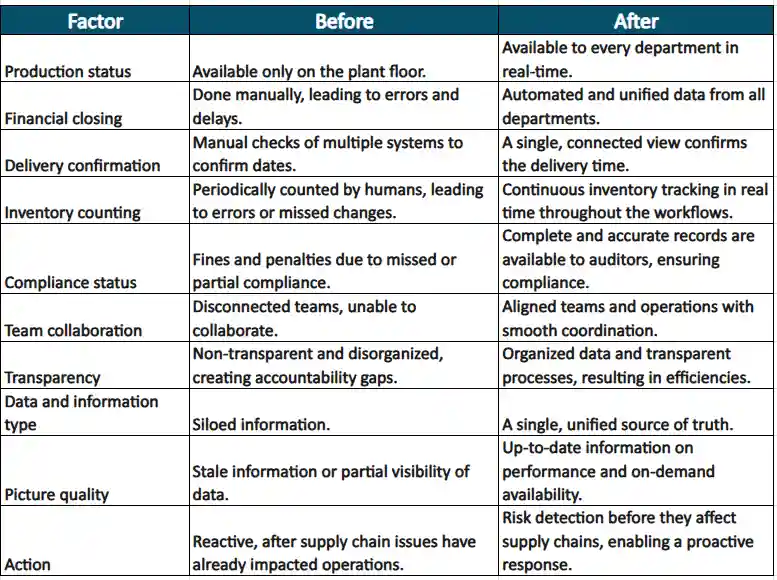
This huge gap highlights the need for proper supply chain visibility software.
Business Impact of Lack of End-to-end Visibility
The lack of real-time insights in packaging companies translates into the following business outcomes:
Customer Trust Loss
Delayed deliveries, stockouts, and quality issues erode customer trust in your business. And this arises from missing or partial data visibility. Such missed commitments don’t just disappoint customers but push loyalty toward competitors.
Operational Inefficiencies
Lack of data visibility in the packaging industry means no single source of truth, resulting in:
- No accurate inventory count
- Team coordination suffers
- Inaccurate financials and reports
- Wrong or delayed decisions
- Overdue, erroneous, or no delivery to customers
- Reactive response to changes and events
These are signs of operational inefficiencies, which become more frequent in the absence of data visibility.
Compliance Risks
Fragmented and outdated packaging data makes operational reporting unreliable and prevents teams from tracing information back to source records. This limited traceability makes compliance reporting and audits difficult to manage.
Financial Effects
- Manual data reconciliation means time and effort lost in non-strategic tasks.
- Missed orders mean revenue losses.
- Understocking means client loss, and overstocking means high carrying costs.
- Non-traceability and non-compliance mean fines and penalties.
- Partial data visibility or outdated information means wrong decisions.
These aspects quietly increase your costs and erode your margins.

Benefits of Real-time Data Visibility in Packaging Operations
On the contrary, if unified real-time inventory visibility for packaging companies is possible, the impact reverses:
You Respond More Accurately to Customers
Real-time data visibility helps with information on inventory levels, production status, and finished product delivery dates. Accurate delivery commitments make customers happy, strengthening trust and retention.
You Understand Your Operations Better
Improved data visibility gives you a clear view of operations, enabling faster issue detection as and when they occur, not after the event. This reduces operational blind spots across the business, enabling faster responses.
You Stay Compliant, Consistently
Governed data and complete operational visibility facilitate back-tracing every data point to its source documents and historical records. Data traceability helps prepare audit-ready reports on time and stay compliant with relevant regulations.
Your Decisions are Precise and On Time
The availability of real-time data across every department and insights shared with all employees translate into accurate and on-time decisions across teams.
Your Demand and Supply Planning Improves
With data on material requirements, market demand, and supply availability, you can plan your production. Moreover, inventory levels plus demand data give you an idea of the quantity to order, enabling a supply-demand match. Thus, you can plan proactively rather than reactively.
You Can Spend More Time on Analytics and Insights
Accurate data visibility across all departments increases your finance and analytics teams’ trust in numbers. So, teams can focus more on data analytics and insight generation instead of data verification and reconciliation.
Together, these benefits shift packaging companies from reactive action-takers to proactive decision-makers.
Buyer Checklist For an Ideal Supply Chain Visibility Software
“What should the right packaging ERP software deliver?”
Does it Provide One Source of Truth?
Suppose the CRM shows available stock, while the warehousing system shows outdated inventory. This means a misaligned inventory count. Such conflicting numbers create confusion, slow decision-making, and increase risks.
Therefore, packaging automation software must consolidate data across systems and departments to facilitate a single source of truth that facilitates decision-making. Instead of debating and verifying numbers, the team must spend time on strategizing.
Does it Capture Both the Internal and External Picture?
Suppose the delivery of the paper used for packaging is delayed. The manufacturer, unaware of this problem, has scheduled production. This results in idle machines and rescheduling chaos.
Data visibility from a packaging ERP software must be end-to-end, highlighting delays and alerting the respective teams. Vendors’ supply and delivery to customers are external events, but must be tracked continuously to ensure a smooth packaging lifecycle. Updates must be in real time, so all stakeholders stay aligned.
Does It Help You Scale?
Three more plants in the future. Increase in SKUs. Rise in the volume of orders. More acquisitions. These are all signs of scalability and growth.
But growth also adds layers of systems, data, and complexity that can be managed only with clear visibility.
Your supply chain visibility software must be able to manage this operational growth due to new additions with clear and complete visibility. The data across additional layers must be standardized to create a unified, single view of all operations.
Does It Improve Decision-making And Planning Speed?
Festivals cause a spike in demand for flexible packaging, as proven by historical data. Imagine you don’t forecast this, and the production is as usual. In this case, you’ll be underproducing, resulting in delivery failures.
The data visibility solution must provide Copilot-assisted packaging analytics and insights. Making sense of the data, predicting accurately, and planning smartly for the future are essential. These data-driven decisions, including demand forecasts, exception alerts, and production recommendations, protect margins.
Does It Provide Real-time, Automated Visibility?
Suppose production has stopped abruptly, but the manager realizes it after a few hours. A raw material finishes mid-shift, but the system updates it at the end of the day.
It requires immediate response and action, which is possible only if data visibility is in real-time. If not, production stops, the supply chain lifecycle is disturbed entirely, and costs increase.
To avoid these ripple effects across operations, the packaging ERP software must give real-time visibility to help prepare for uncertain situations and unplanned breakdowns. This drives proactive action readiness even before the event occurs.
This is where Microsoft Dynamics 365 fits in well to facilitate informed, fast, and data-driven decision-making.
How Dynamics 365 Supply Chain Management Enables Supply Chain Visibility for Packaging Companies
Microsoft Dynamics 365 enables a central point connecting data, processes, and decisions. These features together create a unified supply chain visibility for packaging companies.
Here’s how Dynamics 365’s capabilities drive packaging operational efficiency:
End-to-end Visibility
Dynamics 365 integrates finance, supply chain, inventory, production, sales, and customer service. It also gathers data from IoT sensors and robotics, bringing it all to a single platform. This eliminates silos and connects operations.
This integration creates a unified data model to ensure complete, integrated visibility of all departments and operations. Thus, finance, sales, and service teams work from the same data as operations, production, and supply chain staff.
Connected workflows provide end-to-end visibility across the entire supply chain, from raw material availability to shipment for delivery, including production and order fulfilment. This ensures accountability at every stage and builds supply chain resilience.
Predictive Insights and Proactive Planning
Dynamics 365 combines Microsoft Copilot, agents, and business intelligence capabilities that leverage the integrated, single view of data to deliver business insights. These enable you to:
- Plan inventory stocking
- Forecast demand
- Adjust production schedules based on internal and external changes
- Predict supply chain disruptions and act accordingly
- Ensure faster month-end closing
- Assess vendor performance
- Use the Procurement Agent to follow up on purchase orders, review supplier updates, and identify the downstream impact of changes
- Analyze margins accurately
- Generate event alerts to take relevant action on time
These activities ensure on-time delivery, less wastage, financial accuracy, and better resource utilization. These are hallmarks of operational efficiencies and employee productivity.
Real-time Decision-making
Dynamics 365’s real-time data visibility provides an up-to-date view across the entire supply chain, enabling timely and accurate decision-making. It provides:
- Up-to-the-minute inventory data
- Constant monitoring of inventory and production status
- On-demand answers and guided actions through Copilot
- Assessment of past data and market signals
These features help align inventory allocation with actual availability and meet exact customer expectations with accurate order fulfilment. Moreover, integrated analytics and business intelligence turn raw data into insights immediately, ensuring faster, smarter, and on-time decisions.
Consistency and Compliance
Dynamics 365 has built-in checkpoints to help monitor processes, raw materials, and finished products. Such automated quality control supports compliance with quality standards and regulatory laws.
Moreover, automation replaces all manual processes, reducing the likelihood of errors. Planned inspection schedules and batch tracking leave a trail that is helpful during audits. Also, Dynamics 365’s reporting tools and capabilities help generate insightful reports and documents required by auditors.
All these features enable you to comply with relevant regulations and be consistent in your product quality, building customer trust along the way.
Why Implementation Expertise Matters
The buyer checklist for a Copilot-assisted packaging analytics solution covers the technology part. The Microsoft Dynamics 365 platform addresses it well.
The second part of the equation is execution. If implemented successfully and leveraged fully by a business, only then will you realize the solution’s maximum ROI.
Additionally, packaging companies offer a different set of complexities that need to be factored into the solution. Their intricacies include:
- Mixed production models
- Variable units of measure
- Existing legacy systems
- Multi-stage production process
- Multiple acquisitions and data from those
- High SKU customization
An expert vendor managing all these aspects can ensure successful implementation. It will need to:
- Align the implementation strategy with business goals
- Get the right sources for clean, structured, and consistent data
- Design new workflows to align with Dynamics 365’s packaging capabilities
- Execute a phased rollout to reduce downtime and operational disruption
- Manage change management and user training strategically for maximum output
- Enable the team to fully leverage the solution’s data visibility capabilities
This is exactly why implementation expertise matters.
Intech’s Approach to Improve Data Visibility in The Packaging Industry
Intech Systems is a Microsoft Solutions Partner with experience delivering Copilot-enabled business applications and industry-focused transformation. For packaging manufacturers, our focus is on connecting estimation, planning, production, shop-floor data, inventory traceability, finance, sales, and service on a scalable Microsoft platform.
Our Microsoft expertise supports Copilot-led growth alongside technology implementation. We help packaging businesses use Dynamics 365, Copilot, relevant agents, analytics, automation, and tailored extensions to turn connected data into practical outcomes such as more reliable planning, better margin visibility, stronger traceability, and faster decisions.
Our data visibility in the packaging industry approach involves the following steps:
Step 1: Data Landscape Audit
We study your current data landscape to understand data visibility issues in areas where:
- Decisions are delayed
- Data is handled manually
- Continuous monitoring is missing
- Teams are unable to collaborate
- There’s a mismatch of numbers
These are the data visibility breakdown points causing a loss in value. They affect decision-making and quietly eat into your finances. Identifying these areas helps align the solution to outcomes.
Step 2: Solution Design Based on Business Requirements
Replicating legacy workflows would limit the value of Dynamics 365. Instead, we match the solution design to your packaging business requirements by considering the following:
- Packaging-specific workflows
- Data models
- Units of measure
- Coordination between several plants
- Alignment with make-to-order vs make-to-stock
This helps align your solution with your plant’s operations, strengthening data visibility outcomes.
Step 3: Data Cleaning, Structuring, and Standardization
What creates complete and clear data visibility?
Data with the following attributes:
- Is clean
- Structured well
- Standardized because it is sourced from several devices
- No duplicates or conflicting records
- Consistency in formats and classification
Our data experts manage this before actual implementation, so you can trust both your data and the outcomes Dynamics 365 delivers.
Step 4: Customization For Real Adoption
Actual deployment and real adoption happen when you get the expected outcomes. And this results from a solution intertwined with your daily workflows and decision-making process. To achieve this, Intech focuses on the following:
- Strong change management initiatives
- User training based on roles, departments, and skills
- Role-based dashboard creation for every sub-function
- Designing workflows to align with daily packaging operations
Thus, Dynamics 365 not only functions but also proves usable in generating complete and clear business views. We ensure Dynamics 365 becomes a part of your regular processes to deliver high ROI.
Step 5: Continuous Optimization
Data visibility is a daily, real-time requirement. To sustain it, the solution must be optimized continuously as your business evolves.
Intech’s Dynamics 365 experts continuously improve and upgrade:
- Reporting structures
- KPI frameworks
- Forecasting models
- Planning contexts
- Workflows
Such continuous solution optimization enhances your data visibility, resulting in faster decision cycles.
Build Resilient Packaging Operations With Intech
For packaging companies, real-time insights, unified operations, and faster decision-making are practical requirements, especially when the pressure is to reduce costs, respond faster, and build resilience.
This is possible only with an expansive, clear view of your data. Better data visibility so that you have to deal with fewer blind spots and surprises. This facilitates better planning, informed decision-making, enhanced responsiveness, reliable deliveries, and stronger margin control.
Microsoft Dynamics 365 provides the connected foundation. Intech helps translate it into packaging-specific outcomes by aligning the platform with production models, units of measure, shop-floor workflows, inventory traceability, quality processes, and multi-plant operations.
Ready to improve packaging data visibility, planning accuracy, and margin control?
Start with an Intech data visibility assessment to identify blind spots, prioritize high-value use cases, and build a phased Dynamics 365 roadmap focused on measurable operational outcomes. Get started today: https://intech-systems.com/industries/manufacturing/packaging/#build-the-future.
About the Author

Frequently Asked Questions
Data visibility in the packaging industry means a real-time, complete view of operations, including inventory, production, procurement, supply chain, finance, and sales. Intech’s packaging solutions connect these workflows on a scalable Microsoft platform.
Data visibility produces insights that help teams plan, make decisions, and act faster. Dynamics 365 Supply Chain Management supports demand forecasting, inventory planning, production visibility, procurement, warehousing, and fulfilment, helping reduce waste and protect margins.
Data visibility shows how operations are performing and where issues are developing. Packaging manufacturers can use this view to correct inefficiencies, coordinate teams, strengthen traceability, and support compliance. Intech aligns these capabilities with packaging-specific workflows.
External events and internal conditions can affect packaging operations at any time. Real-time data helps teams respond faster, make accurate decisions, and prevent avoidable delays. Intech’s connected manufacturing approach brings planning, production, inventory, and shop-floor data into one operating view.
Poor data visibility can cause delayed decisions, missed deliveries, inaccurate inventory, production disruption, quality issues, and weak margin control. Intech helps identify these breakdown points through a data landscape assessment and a phased implementation roadmap.