


Introduction
AI is moving fast, but trust, control, and accountability still decide whether it creates business value. As enterprises adopt AI across critical functions, human oversight is becoming central to building systems that are scalable, safe, and compliant.
It is not just a compliance obligation. It is a solution to a problem that enterprises already had.
Think of it less as a constraint on automation and more as intelligence built into the AI system’s design, development, and use.
As capable as these AI systems are for business process automation, they can also create risk if no safety mechanisms exist for their use and deployment. With HITL in place, AI-led automation works for businesses, earns trust, and stays compliant.
Microsoft Copilot Studio is the perfect example of human-in-the-loop AI.
The blog explores the HITL concept, the gaps it addresses, use cases, and benefits with Microsoft Copilot Studio in focus.
Gaps in AI Workflow Automation Solutions: Where and Why They Break Down?
Generally, the gaps in AI workflow automation solutions are not easy to spot. They lie somewhere in poorly designed or ungoverned workflows that don’t function as planned.
Over Automation
Automating simple, repetitive tasks with low risks? AI does the work.
But when the function is critical and the risks are real, it’s better to balance AI automation and human intelligence. There are points where human judgment is irreplaceable, such as anomaly detection, exception handling, or high-stakes approvals. Automating these means wrong investment and operational decisions, affecting business profits.
Unclear Ownership
Suppose an AI-driven decision causes damage. Who is responsible? Who owns it?
No one does. Teams point fingers at each other because escalation paths were never defined, and exception handling was not built in. Accountability doesn’t disappear. Now, it is everyone’s problem.
Missing Audit Trails
When a regulator asks: Who made a specific decision? Why? Based on what data?
Your answer in the case of AI workflow automation solutions is silence. Because they weren’t built with traceability and auditability in mind. With no clear audit trails, you might struggle with compliance, reviews, and risk assessments..
Also Read: How AI Agents Are Redefining the Market Research Landscape
Loss of Trust
This is not an inherent gap, but it happens gradually due to the above gaps. When you witness unexplained errors, a pile of unhandled exceptions, and erratic approval processes, it’s just people trying to work around AI rather than with it.
Eventually, AI agents exist on paper, but in practice, businesses bypass them due to lost trust. That’s not actual automation.
In summary, these gaps lead to either underutilization of AI in low-value tasks or deployment at scale without controls. None of these creates sustainable value.
Gartner predicts that over 40% of agentic AI projects will be cancelled by 2027-end due to insufficient risk controls, unclear benefits, or rising AI costs. The first two causes can be solved with active human involvement.
The Solution: Human-in-the-loop AI
The solution isn’t less automation. It’s building a controlled layer within which AI acts, where humans provide accountability, decision-making, traceability, and approvals. This facilitates smooth AI scalability and value creation.
This is called human-in-the-loop AI.
What is Human-in-the-loop AI?
At its core, human-in-the-loop AI is a risk management technique.
When the risk is low, AI automation works best. But if you face high risks, complex decisions, or uncertain situations, it’s better to have a human’s involvement in the process. Be it when setting up the system, evaluating high-risk options affecting the decision, validating a choice, or taking action.
Human intelligence expands your AI system’s capabilities. While AI automates your workflows, humans determine and control the level of automation.
In practice, HITL looks like this:
AI systems perform a task à A pre-defined condition triggers human intervention à Humans review, approve, escalate, or correct à Human action is inserted in the system à AI completes the task.
Clean. Governed. Traceable.
That’s controlled autonomy in AI.
Why is Human Oversight Important in AI?
Human and AI collaboration is critical for businesses to ensure safe, scalable, and context-specific results.
Humans interact with AI systems when:
- Outputs need verification and validation for accuracy
- Workflows need approvals at the right time for further processing
- Business models need fine-tuning to align with situations
- Operations need context and supervision
- Odd incidents or edge cases need proper reasoning
- Processes need proper structure, shape, and logic
- Decisions need to be made with low or no data inputs
- AI agents’ performances do not align with organizational goals
All of this is human judgment in different forms. AI lacks it; so, humans provide judgment in enterprise workflows.
Not every transaction needs a human. But when stakes are high, risks are real, and output is business-critical, get humans in the loop. Moreover, HITL is not an option now. The EU AI Act makes human oversight mandatory for high-risk AI systems.
What Does the Solution Look Like in Practice: Microsoft Copilot Studio Features and Benefits
Microsoft Copilot Studio is the perfect example of HITL in practice. It is the platform for building, governing, and scaling AI agents with human intervention, designed and managed at strategic points.
Microsoft Copilot Studio allows you to:
- Create agents with conversational and autonomous capabilities
- Customize them with structured guidelines, organization’s information, prompts, and APIs
- Integrate them with business apps, deploy them in Microsoft 365 solutions, or embed them in websites or social platforms
Manage their work, govern through controls, access analytics and reports, and maintain compliance.
How Does Microsoft Copilot Studio Work?
Here’s what makes Microsoft Copilot Studio the right platform for HITL design:
Approvals and Access
Microsoft Copilot Studio creates role-based access and approvals at multiple stages using AI approvals. This allows decision forwarding to the right person based on business logic, helping you drill down into clear ownership and responsibility mapping.
Activity Logging
It uses timestamps and user IDs to log activities based on the decision context, including approvals, agent actions, and other human interventions. You can also review them during audits or for modification purposes.
Context-ready Decisions
The AI agent escalates a decision to a human with a notification containing the full context. Humans get complete information on:
- What decision is required
- Input data used by agents for analysis
- Options available
- Consequences of each decision
Flexible Workflows
Microsoft Copilot Studio’s control layers add flexibility to workflows:
- Approvals are based on thresholds
- There’s logic defined for handling exceptions
- Routing of decisions to the right person is based on conditions
With your enterprise’s existing Microsoft solutions like Teams, SharePoint, Outlook, and others, Copilot Studio becomes the silver lining. Just integrate with existing solutions, and you have the added intelligence.
Human-in-the-loop AI Examples
Let’s look at some of the human-in-the-loop AI examples.
CRM
Customer discounts vary, and so should the approval logic. If automatic approvals apply for all customers, you cannot vary discount rates.
The Microsoft Copilot Studio agent monitors customers and their transactions. The approval authority gets an alert with details on customer history, proposed discount, deal context, and margin impact. One tap, and it’s approved or rejected, saving time and improving productivity.
Finance
Invoice processing is cumbersome, involving manual matching, exception handling, and approval routing.
An AI agent handles straight-through processing for clean, matched invoices. But when faced with duplicate vendor IDs, huge amounts, or first-time vendors, a human checkpoint is essential. The Accounts Payable Manager receives an alert with full details about the vendor, risk, and amount to approve or reject.
Compliance
Financial services firms’ compliance teams handle high-volume customer onboarding documents for review with tight timelines and zero tolerance for error.
An agent pre-scores risk levels to divide customers into low, medium, and high. Low-risk customers get automatic approval. A pre-built summary is used to review medium-risk customers. High-risk customers escalate to the compliance officer with a complete risk summary.
ERP
A distribution company’s CRM solution updates records, which are synced back to the ERP. But validation before landing in ERP is missing. Incorrect entries cause order fulfilment failures.
An AI agent automatically validates each low-risk update (names or phone numbers) based on pre-defined rules. When updates affect payment terms or credit limits or are perceived as highly risky, a human intervenes. If approved, it syncs to the ERP; if rejected, it doesn’t.
Content Moderation
Online platforms constantly witness loads of inappropriate text, videos, or images that violate community guidelines.
A Microsoft Copilot agent automatically removes or disallows content containing violating language or images. But when it is not evident or is confusing, the agent flags it for human review.
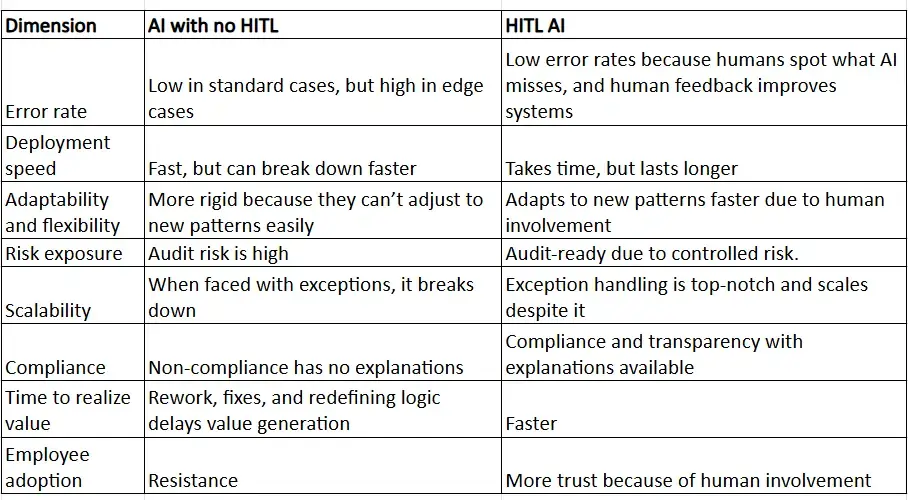
Business Benefits: Autonomous AI vs Human-in-the-loop AI
McKinsey’s ‘The State of AI in 2025’ report found that organizations generating the largest returns from AI are more likely to follow the HITL strategy. It means organizations have well-defined human validation processes built into their workflows.
The data gives clear results. Humans-in-the-loop AI systems do not slow down the process; instead, they generate high-quality outcomes. This is because the HITL strategy is woven into the AI system’s fabric, and governance is designed to manage its use.
The Intech Approach: Your Microsoft Copilot Studio Implementation Partner
Intech Systems is a trusted Microsoft Copilot Jumpstart Ready partner, specializing in enterprise AI transformation. Our services include:
- Designing and building custom copilots
- End-to-end implementation
- Seamless integration with existing solutions
- Ongoing support and optimization through the AI Centre of Excellence
We create agents using Microsoft Copilot Studio and Azure AI that are compliant, audit-ready, and customized for your business environments. Human and AI collaboration is our AI design discipline to deliver business value, not a feature added at the end.
As a human-in-the-loop AI solutions provider, our structured approach includes the following steps:
Phase 1: Workflow Mapping
We start with understanding your target workflow. We focus on the decision points, possible exceptions, and areas where human oversight can add value. Based on this assessment, we define agent roles, ownership structure, escalation points, approvals required, validations, and exceptions that involve only human judgment.
Phase 2: Human-in-the-loop AI System Design and Governance Plan
The first phase forms the foundation for designing Microsoft Copilot Studio agents. In phase 2, we define decision ownership, agent and human roles, exception-handling responsibilities, performance review authority, and audit requirements.
Logic and governance run parallel while defining the agent’s core to generate ethical and logical output from the start. Defining the threshold adjustment conditions when retraining agents will be required is also essential.
Phase 3: Deployment and Integration
We use secure and governed connectors to integrate Microsoft Copilot Studio agents with your existing platforms. The workflows are configured to run on the principle of controlled autonomy and not full automation.
Phase 4: Pilot, Measure, and Iterate
Before rolling out broadly, we conduct a small pilot with one workflow for one team for a short timeframe. It helps detect edge cases that weren’t identified earlier. Moreover, metrics help you decide the enterprise-wide rollout with or without modifications.
Our Microsoft Copilot Jumpstart partnership enables us to facilitate a Microsoft-funded Proof of Concept for you. We help you adopt Copilot by building and customizing a validated and ready-to-scale HITL agent for one of your workflows.
What’s Next?
Full autonomy by deploying AI agents sounds efficient. But one compliance gap, one unowned decision, one missing audit trail, and the entire process becomes questionable.
Human-in-the-loop AI provides automation benefits plus clear ownership, well-defined audit trails, and full visibility, resulting in trust. Implemented through Microsoft Copilot Studio, HITL is a more practical path toward automation with accountability. Such controlled autonomy makes enterprises more trusted, governed, and scalable.
The right amount of autonomy plus the right context by the right humans at the right time is what defines an AI system. This is how you manage human and AI collaboration. That is what we at Intech Systems build using Microsoft Copilot Studio. Learn more about Copilot Studio here: https://intech-systems.com/ai-solutions/ai-powered-intelligent-apps/copilot-studio/.
Get Started
Ready to shift from full autonomy to controlled autonomy?
Work with Intech Systems, a Microsoft Copilot Jumpstart Ready Partner, to design controlled, enterprise-ready AI agents that are secure, governed, and built for real business impact.
From strategy and workflow design to implementation, governance, and Microsoft-funded proof of concept support, we help you move from AI experimentation to scalable adoption. Activate a PoC today: https://intech-systems.com/ai-solutions/ai-powered-intelligent-apps/copilot-studio/#credibility.
About the Author

Frequently Asked Questions
No. Low-risk and repetitive tasks can run with minimal intervention. Human oversight matters most when decisions are high-impact, exception-heavy, or compliance-sensitive.
It brings control to automation. Teams get better visibility, clearer ownership, and more confidence in decisions made with AI.
Yes. It can route decisions, trigger approvals, and escalate exceptions based on business rules, so people step in only when needed.
A focused pilot can usually begin in a few weeks. The timeline depends on workflow complexity, integrations, and governance needs.
Intech helps map workflows, design approval logic, build Copilot Studio agents, and govern deployment so your AI solutions are practical and enterprise-ready.